A Holiday Highway Surprise: Reindeer Bring Traffic to a Standstill
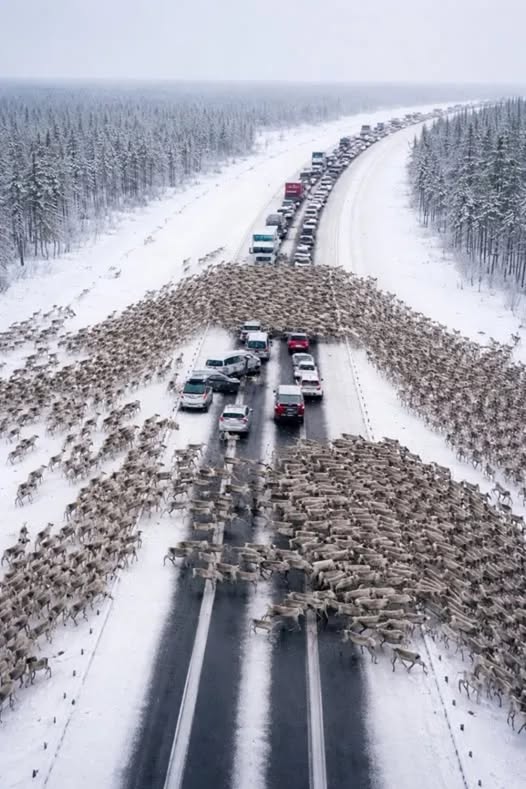
The highway was quiet, wrapped in winter stillness just days before Christmas. Snow dusted the trees like icing, cars moved slowly, and drivers were lost in holiday thoughts—dinners, gifts, family reunions. Nothing hinted that this ordinary commute would turn unforgettable.
Then came the sound.
A low, rolling boom—not thunder, not an explosion—but something older, heavier, primal. Brake lights flickered as drivers instinctively slowed, exchanging puzzled glances through frosted windshields. Moments later, the forest erupted.
The first reindeer burst onto the road, powerful legs propelling them, eyes wide with panic. A handful at first, darting across lanes, hooves striking asphalt. Drivers slammed brakes, horns blared, doors flew open.
Then more came.
Dozens turned into hundreds, hundreds into thousands. The highway became a living river of fur and hooves, surging forward as one, the earth itself seeming to move beneath them. Cars stood frozen in disbelief. Some laughed nervously. Others whispered: “It’s a Christmas miracle.” Phones captured every second, social media exploded with videos tagged #ReindeerRun, #SantaSightings, #Unreal.
For a few moments, wonder eclipsed fear.
But then reality hit.
This wasn’t a parade. The reindeer were fleeing. High in the mountains, an avalanche had thundered down without warning, tearing through forest and snowpack. Trees toppled like matchsticks. The herd sensed danger before humans had a chance to register it—vibrations, pressure shifts, subtle signals built into survival itself. Their instinct drove them straight onto the highway.
What had felt magical was now terrifyingly real. Phones lowered. Smiles faded. This wasn’t a holiday spectacle—it was a mass exodus, animals driven by fear and the instinct to survive.
Silence settled over the highway. The chaos of honking and complaining disappeared. Drivers watched the last of the reindeer disappear into the distance. Emergency crews assessed avalanche risks, wildlife officials coordinated responses, and authorities ensured safety. Hours later, traffic resumed, but no one rushed. Something had shifted.
For a brief moment, humans were reminded how fragile control really is. How quickly calm can dissolve. How nature moves on its own terms. The event became an unexpected lesson in wildlife behavior, climate volatility, and respect for natural instincts—more impactful than any documentary.
Scientists later analyzed the event, noting the rare alignment of migration instincts, extreme weather, and human infrastructure. Conservationists emphasized the importance of protecting migration corridors and understanding animal behavior. But for those who lived it, the lesson wasn’t technical—it was visceral.
The image stayed: thousands of reindeer surging across asphalt, ancient instincts colliding with modern life. They didn’t stop. They didn’t look back. They ran until they were safe, and in doing so, reminded humans that life moves whether we’re ready or not.
Drivers returned to their cars, engines humming, traffic flowing again. Yet the sense of awe lingered—a quiet humility, a renewed perspective. Sometimes delays aren’t obstacles—they’re invitations to witness, to reflect, to understand.
This wasn’t magic. It was life asserting itself. Nature protecting its own. Humans forced, for a fleeting moment, to pause and watch.
If this story amazed you, share it—let others witness the power of nature and the incredible instincts that guide it.